
The Deputy Governor for Economic Affairs of Kurdistan Province Emphasizes at the Opening of the 14th Iranian Horticultural Science Congress:
Horticultural Development Plays a Vital Role in Ensuring Food Security
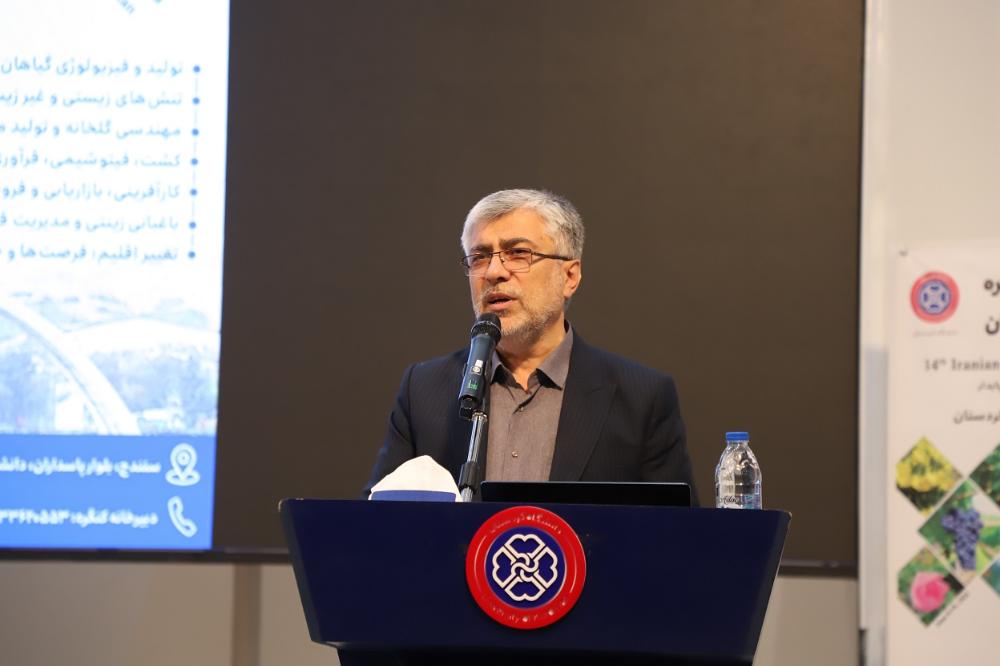



Emphasizing the significance of the agricultural sector, the Deputy Governor for Economic Affairs of Kurdistan Province stated that horticultural development is essential for food security, describing it as a fundamental necessity for modern society.
According to the Public Relations Office of the University of Kurdistan, Arsalan Azhari, speaking on Monday, June 8, 2026, at the opening ceremony of the 14th Iranian Horticultural Science Congress, highlighted the development axes of Kurdistan Province. He noted that within the province's strategic development documents, the sectors of water and agriculture, industry, mining, tourism, and trade are defined as the primary pillars, with water and agriculture held as the top priority.
He stated that Kurdistan Province possesses 1.2 million hectares of agricultural land, with approximately 800,000 to 850,000 hectares under cultivation annually, yielding a total agricultural output of nearly 3.7 million tons.
Azhari further detailed that the province's orchards cover 65,700 hectares, representing approximately two percent of the nation's total orchard area. Similarly, Kurdistan accounts for about two percent of the country's total horticultural production.
He added that Kurdistan maintains a prominent position in several horticultural products, ranking first in the country for strawberry production, second for rain-fed grapes, second for walnuts, and seventh for cherries.
Furthermore, Azhari identified the development of medicinal plants and saffron as key provincial programs, stating that, given the province's inherent capacities, these products can play a significant role in agricultural advancement.
Stressing the importance of food security, he noted that under the current national circumstances, food security is a critical issue, necessitating that scientific and research centers play a more active and influential role in this field.
In conclusion, the official highlighted the role of horticulture in rural employment, asserting that horticultural development can prevent rural-to-urban migration and enhance local livelihoods by creating small-scale employment opportunities.


Quick Links
Electronic Services
Useful Links


University of Kurdistan, Pasdaran Boulevard, Sanandaj, Iran

Postal Code: 6617715175

Phone: +988733664600-8

Email: info@uok.ac.ir


site visit
- today:
- yesterday:
- all:
Last Update
10 Jun 2026 - 05:35:56